~ Welcome to Our Store ~
~ Welcome to Our Store ~
~ Welcome to Our Store ~

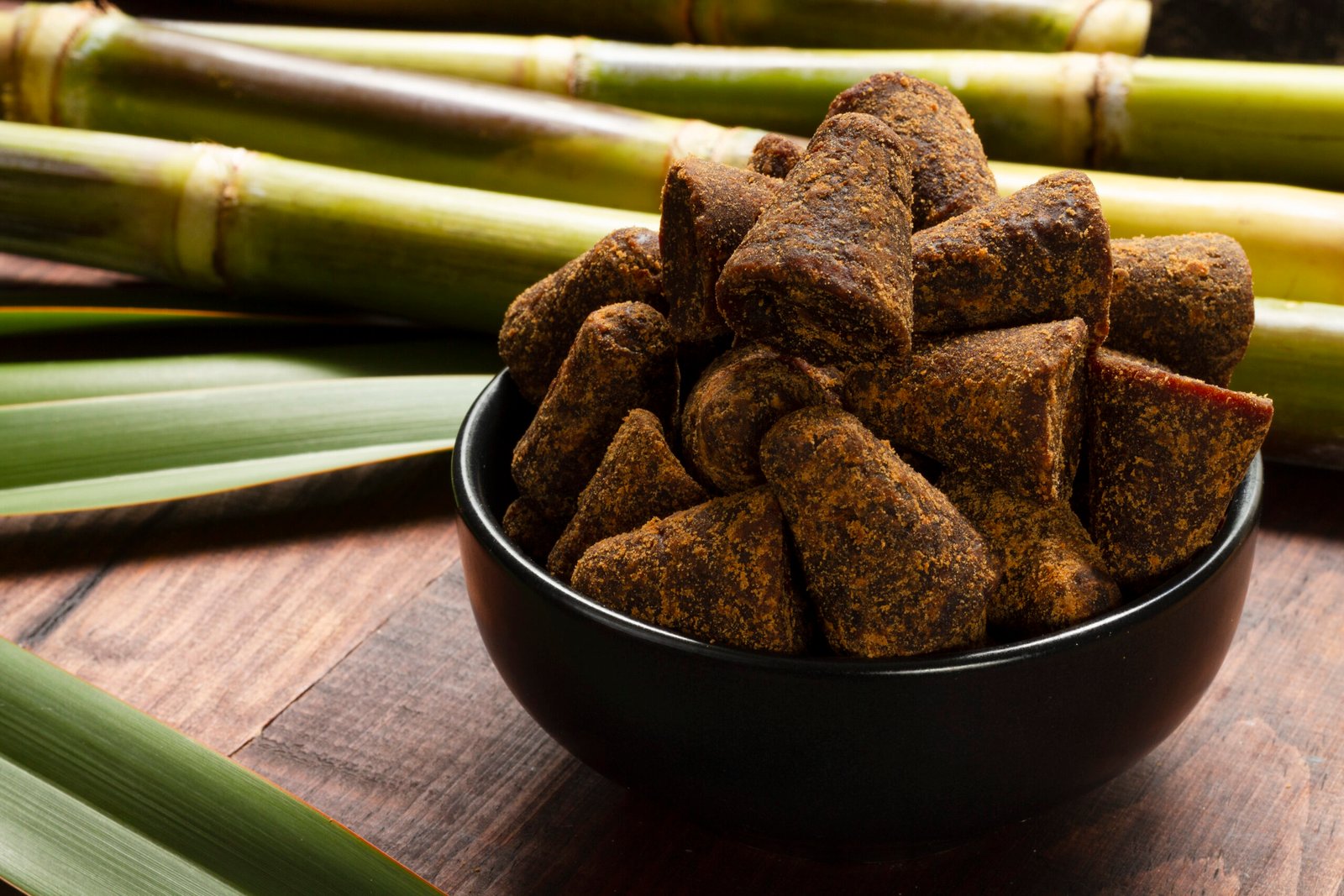
There was a time when sweetness came from simplicity.
Before white sugar filled every jar, before packaged desserts dominated shelves, families relied on something earthy, rich, and wholesome.
That sweetness was jaggery.
Today, we consume sugar daily — in tea, coffee, biscuits, bread, sauces, and even “healthy” snacks. It dissolves quickly, looks clean, and tastes sharp.
But in that shine and refinement, we forgot something important.
We forgot how sweetness was meant to nourish, not just stimulate.
Let us return to that simple truth.
The Difference Begins at Processing
The biggest difference between jaggery and sugar lies in how they are made.
Refined sugar goes through heavy industrial processing:
- Chemical clarification
- High-speed centrifuging
- Sulphur bleaching
- Removal of natural molasses
- Refinement into crystal form
What remains is almost pure sucrose — stripped of minerals, stripped of character.
Jaggery, on the other hand, is prepared through a traditional, minimal process:
- Fresh sugarcane juice is extracted.
- The juice is slowly boiled in large pans.
- It thickens naturally.
- It is poured into molds and allowed to cool.
No chemical bleaching.
No aggressive refinement.
No stripping of nutrients.
Jaggery retains natural molasses — the part that carries minerals and depth of flavor.
And that changes everything.
Not Just Sweetness — But Substance
Sugar gives quick energy.
Jaggery gives sustained nourishment.
While jaggery is still a form of sugar and should be consumed in moderation, it contains trace amounts of:
- Iron
- Magnesium
- Potassium
- Calcium
- Antioxidants
These minerals are naturally present in sugarcane juice and remain intact in jaggery because the process is gentle.
Refined sugar contains almost none of these.
In simple words:
Sugar is empty sweetness.
Jaggery is wholesome sweetness.
Why Our Grandparents Preferred Jaggery
If you look back, traditional Indian households rarely stored refined sugar. Instead, they kept blocks of jaggery in steel containers.
After meals, a small piece of jaggery was offered. Not just for taste — but for digestion.
Ayurvedic wisdom suggests jaggery:
- Supports digestion
- Helps cleanse the respiratory tract
- Assists in natural detoxification
- Provides warmth during winter
- Supports iron levels
Farmers consumed jaggery during long working hours because it gave steady energy without sudden crashes.
It was simple, affordable, and trusted.
Somehow, modernization replaced it with white crystals that looked “cleaner” — but were nutritionally poorer.
The Blood Sugar Question
One common question arises:
“Is jaggery safe for diabetics?”
The honest answer is this:
Jaggery and sugar both impact blood glucose levels because both contain sucrose. Jaggery is not a medicine for diabetes.
However, jaggery has a slightly lower glycemic load compared to refined sugar and provides additional micronutrients.
The key is moderation.
Replacing excessive refined sugar with small, mindful amounts of natural jaggery can be a healthier choice — but not a license to overconsume.
Sweetness should complement life, not dominate it.
The Taste That Feels Real
Have you noticed the flavor difference?
Sugar tastes sharp and one-dimensional.
Jaggery tastes deep, earthy, and slightly caramel-like.
It carries the memory of soil, sun, and sugarcane fields.
Add jaggery to tea — it feels warmer.
Add it to kheer — it feels richer.
Add it to sesame laddoos — it feels traditional.
Taste is not just about sweetness intensity.
It is about depth.
Jaggery adds character to food. Sugar only adds sweetness.
Chemical-Free Matters More Than We Think
Refined sugar often involves sulphur processing for bleaching and whitening. The goal is visual appeal — bright white crystals that look pure.
But nature rarely produces anything that perfectly white.
Jaggery’s brown or golden color comes from molasses and minerals. It is not bleached. It is not polished for appearance.
In a world where food is engineered for looks, jaggery remains honest.
The darker tone is not a flaw.
It is proof of minimal processing.
Energy Without the Crash
Refined sugar enters the bloodstream quickly, causing a spike in energy — followed by a sudden drop.
That crash makes you crave more sugar.
It becomes a cycle.
Jaggery, because of its mineral content and slightly complex structure, releases energy more gradually. It still raises blood sugar, but often in a steadier way.
That is why rural workers traditionally consumed jaggery water or jaggery with peanuts during long days in the fields.
It supported endurance.
Not addiction.
Supporting Local Farmers and Sustainable Practices
Choosing jaggery is not just about health.
It also supports traditional farming communities.
Small-scale jaggery production often involves:
- Local sugarcane farmers
- Traditional boiling units
- Seasonal rural employment
- Minimal industrial intervention
By choosing naturally prepared jaggery, consumers support decentralized agriculture rather than large industrial sugar refineries.
It becomes a conscious decision — not just a dietary one.
When Sweetness Became an Industry
Sugar became popular because it was convenient.
It dissolves instantly.
It stores easily.
It standardizes taste.
Industries prefer consistency.
But consistency often comes at the cost of nutrition.
Over time, we normalized excessive sugar consumption — in processed foods, beverages, bakery products, and even savory items.
The result?
Rising lifestyle issues.
Energy imbalances.
Dependence on artificial sweetness.
Perhaps the solution is not eliminating sweetness — but redefining it.
How to Replace Sugar with Jaggery in Daily Life
Small changes make a difference.
You can:
- Replace sugar in tea or coffee with grated jaggery
- Use jaggery in traditional sweets
- Add a small piece after meals instead of dessert
- Prepare jaggery syrup for baking
- Mix jaggery with sesame or peanuts for natural snacks
It is not about dramatic changes.
It is about conscious choices.
A Simple Truth We Forgot
The truth is not complicated.
Food was once closer to nature.
Processing was slower.
Ingredients were simpler.
Jaggery represents that simplicity.
It reminds us that sweetness does not have to be empty.
It can carry nutrition.
It can carry tradition.
It can carry responsibility.
Modern life is already full of artificial speed.
Our food does not have to be.